RESEARCH / MECHANISM · PRECURSOR TRIALS

NAD+ research: the mechanism, the precursor trials, and the gaps

How NAD+ is made and consumed, what the oral precursor trials measured, and where the human efficacy data run out.

The short version

NAD+ (a fuel-handling helper molecule every cell uses to make energy) does two jobs: it carries electrons during metabolism, and it gets used up by maintenance enzymes called sirtuins (cellular-maintenance enzymes that can't work without NAD+), PARPs and CD38. The body builds NAD+ three ways and recycles it through a salvage loop. Levels fall with age. The strongest human studies test precursors (building blocks like NR and NMN) taken by mouth, and they reliably raise blood NAD+. This page walks through the mechanism and the trials, finding by finding.

Mechanism: the cell's redox runtime

NAD+ sits at the center of energy metabolism. As the NAD+/NADH redox couple (redox = chemistry that shuttles electrons to release energy), it carries electrons through glycolysis, the TCA cycle and mitochondrial oxidative phosphorylation to make ATP [5]. Beyond redox, NAD+ is a consumed substrate — not just a catalyst — for three enzyme families: sirtuins (SIRT1-7), which deacylate proteins to regulate metabolism and stress resistance; PARP1, which spends NAD+ to repair damaged DNA; and CD38, an ectoenzyme that hydrolyzes NAD+ to generate signaling messengers [5][11].

Those consumers compete for one shared NAD+ pool, which is why the pool can run low. With age, CD38 activity rises and tissue NAD+ falls; in mice, deleting CD38 preserves NAD+ and SIRT3 activity and protects mitochondrial function [2]. This is the mechanistic case for boosting NAD+ — and it is largely a rodent and in-vitro case so far [PRECLINICAL].

How NAD+ is built: the three-pathway pipeline

Mammalian cells build NAD+ through three biosynthetic routes, conserved from bacteria to humans [10]. The de novo pathway starts from the amino acid tryptophan and runs through the kynurenine route. The Preiss-Handler pathway starts from nicotinic acid (niacin). The salvage pathway — the dominant route in mammals — recycles nicotinamide back into NAD+ through the rate-limiting enzyme NAMPT, then NMNAT [5][10]. Because salvage is rate-limited by NAMPT, the cell's NAD+ output is gated at a single step, which is exactly why an upstream input can matter.

The studied precursors plug into this pipeline as inputs. Nicotinamide riboside (NR) is converted to NMN by the kinases NRK1/NRK2, then to NAD+ — a route that bypasses Preiss-Handler. NMN is one biochemical step from NAD+ via NMNAT. Both feed the same downstream pool, which is why oral NR and NMN both raise blood NAD+ [3][4]. A useful mental model: the three pathways are independent build routes that all compile to the same NAD+ artifact, and supplementing a precursor is feeding the pipeline a pre-staged input rather than the finished product. NAD+ itself, fed orally, is the wrong shape to enter cleanly — it is degraded outside the cell before uptake [12].

Nicotinamide riboside (NR): the most-studied oral NAD+ precursor

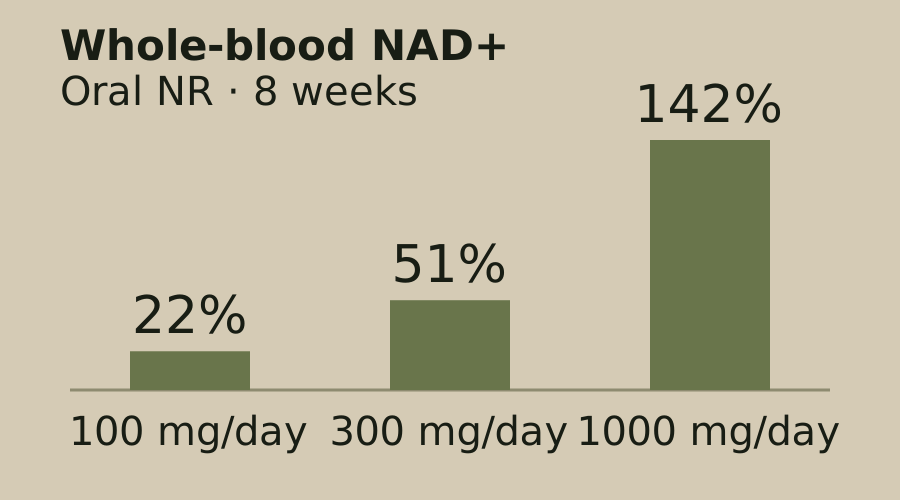
Nicotinamide riboside is the most clinically studied oral NAD+ booster. In a randomized, double-blind, placebo-controlled trial in healthy overweight adults, NR at 100, 300 and 1000 mg/day for 8 weeks raised whole-blood NAD+ by 22%, 51% and 142% respectively — a clean, dose-dependent response maintained throughout the study [4]. NR did not cause flushing, did not elevate LDL cholesterol, and showed no significant adverse-event difference from placebo at any dose [4] [CITATION-CONFIRMED].

NR has also been pushed to high doses for safety testing. In a randomized safety trial in Parkinson's disease patients, 3000 mg/day for 30 days met its primary safety endpoint with no moderate or severe adverse events and substantially elevated the NAD+ metabolome without depleting methyl donors [9]. NAD+ elevation is reproducible. The open question is what it does downstream.

Nicotinamide mononucleotide (NMN): a one-step NAD+ precursor

Nicotinamide mononucleotide sits one biochemical step from NAD+. In a randomized, multicenter, double-blind, placebo-controlled trial in healthy middle-aged adults, oral NMN at 300, 600 and 900 mg/day for 60 days raised blood NAD+ at every dose at days 30 and 60 versus placebo (p ≤ 0.001); 600 mg/day was identified as the optimal dose, six-minute walking distance improved, and a biological-age measure did not increase, with no safety issues at any dose [3] [CITATION-CONFIRMED].

NMN has also been studied for metabolic endpoints. In a 10-week trial of 250 mg/day in prediabetic, postmenopausal women, muscle insulin sensitivity (measured by hyperinsulinemic-euglycemic clamp) rose significantly, with no change in body composition or HbA1c [6]. One regulatory note: the FDA has taken the position that NMN is excluded from the dietary-supplement definition because it was authorized for investigation as a drug — a contested marketplace dispute, not a settled ban [1].

NAD+ vs NMN: what is the difference?

NAD+ is the coenzyme; NMN is a precursor that the body converts into NAD+. NMN sits one enzymatic step upstream (NMN → NAD+ via NMNAT). Practically, oral NMN is studied as a way to raise the NAD+ pool, because NAD+ itself — molecular weight 663.43 Da — is large, charged and poorly taken up intact by cells [12]. So an "NMN study" measures a precursor; it should never be described as "taking NAD+." The two are different molecules at different points in the same pipeline.

What the research measured: outcomes studied for NAD+ and its precursors

The most reproducible outcome is the pharmacodynamic one: oral precursors raise whole-blood NAD+, dose-dependently and reliably [3][4][14]. Beyond that, individual trials have measured specific functional endpoints — muscle insulin sensitivity rose on NMN 250 mg/day [6]; walking distance improved on NMN 300-900 mg/day [3]; cerebral NAD+ rose on NR 1000 mg/day in Parkinson's disease [7].

The honest framing is that these are scattered, study-specific signals, not an established benefit profile. A 2025 narrative review of NAD+ precursor supplementation in human ageing concluded that trials have shown limited efficacy for hard clinical endpoints, that age-related NAD+ decline has been confirmed in only a limited number of human studies, and that tissue-specific NAD+ data remain sparse [1] [GAP]. "NAD+ benefits" is a research question in progress, not a settled claim. Note too that whole-blood NAD+ is a convenient readout precisely because direct tissue NAD+ sampling in humans is invasive and rare — so most trials measure the pool that is easiest to reach, not necessarily the pool that matters for a given organ.

Where the mechanism work is still rodent and in vitro

Much of the strongest mechanistic and anti-aging data comes from animals and cells, and may not extrapolate to people — a caveat the field states openly [1][5]. Two examples from the current record. In mice, the hepatocyte mitochondrial NAD+ transporter SLC25A47 uses NAD+ to sustain SIRT3 and AMPKα activity; deleting it raised hepatic lipid and promoted liver tumorigenesis, marking the transporter as a metformin-relevant node in fatty-liver biology [PRECLINICAL]. And the extracellular-NAD work showing degradation-before-uptake was done in human skin fibroblasts in vitro, not in a living person [12] [PRECLINICAL]. These are informative about how NAD+ behaves, not proof of a human clinical effect.

Two further cautions belong on the record. NAD+ supports the metabolism of dividing cells, so there is a theoretical concern that boosting it could feed existing cancers; its role in oncology is dual and context-dependent, and caution is advised in cancer populations [CAUTION]. Separately, supplement-grade NMN and NR products vary in purity and actual content, and third-party testing is not guaranteed — a quality-control gap distinct from the biology itself.